

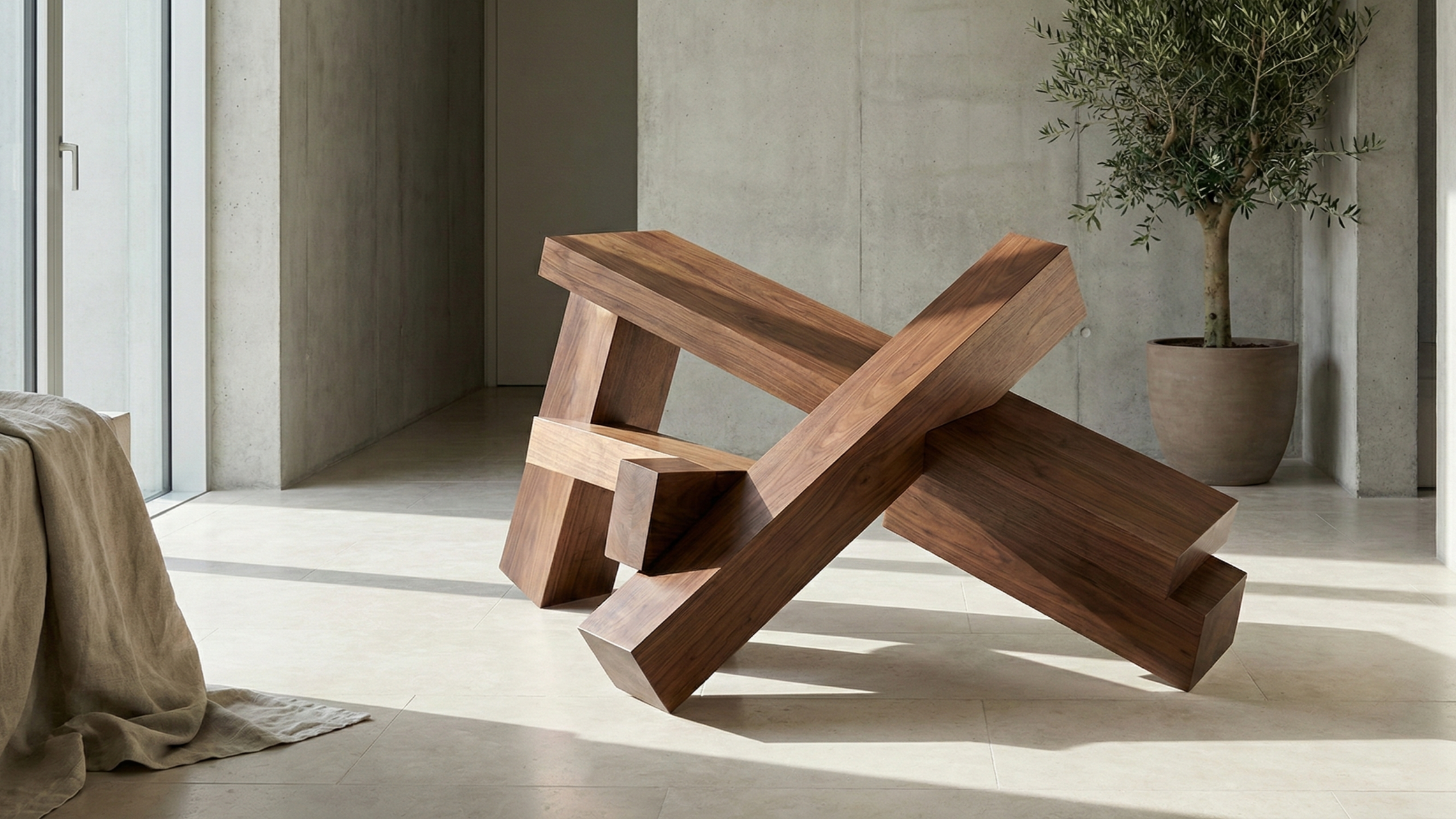
Designing Without a Category
Categories are comfortable. They tell us where things belong. They make furniture easy to describe, sell, and replicate. But they also quietly limit what gets made.
Rustic. Modern. Scandinavian. Mission. Industrial.
Once a piece is labeled, its future is decided. Furniture Lab AI exists to question that assumption.
Designing without a category doesn’t mean abandoning structure—it means abandoning expectation. It means allowing a piece to become what it needs to be instead of forcing it to conform to a predefined identity.
Most furniture today is born already named. The label comes first, the design follows. But the most compelling pieces don’t announce their style. They reveal their intent through form, material, and proportion.
When AI generates furniture concepts, it doesn’t know categories. It doesn’t understand marketing language. It simply explores relationships: mass to void, angle to balance, structure to surface.
That absence of categorization is its greatest strength.
A chair might feel architectural but not modern. A table might feel ancient and futuristic at the same time. These contradictions aren’t problems—they’re opportunities.
Designing without a category gives the maker room to interpret. To decide what matters. To emphasize craftsmanship over classification.
In the workshop, categories disappear anyway. Wood doesn’t care what style it’s supposed to be. It responds to joinery, pressure, grain direction, and time. The material itself resists labels.
Furniture Lab AI aligns with that truth.
By presenting concepts that don’t fit neatly into known styles, it forces the maker to engage more deeply. You’re not building “a modern bench.” You’re building this bench, with these proportions, this tension, this presence.
The result is furniture that feels intentional instead of trendy.
Designing without a category also future-proofs creativity. Trends expire. Categories shift. But pieces built from curiosity rather than conformity remain relevant because they were never chasing approval.
This approach empowers both hobbyists and masters. Beginners aren’t constrained by what they “should” make. Experts aren’t trapped by what they’re known for.
Everyone gets permission to explore.
Furniture Lab AI doesn’t tell you what style to build. It asks what kind of problem you want to solve. What kind of feeling you want to create. What kind of risk you’re willing to take.
When you remove the category, the furniture becomes more honest.
It stops trying to fit in and starts standing on its own.
That’s where originality lives—not between styles, but beyond them.
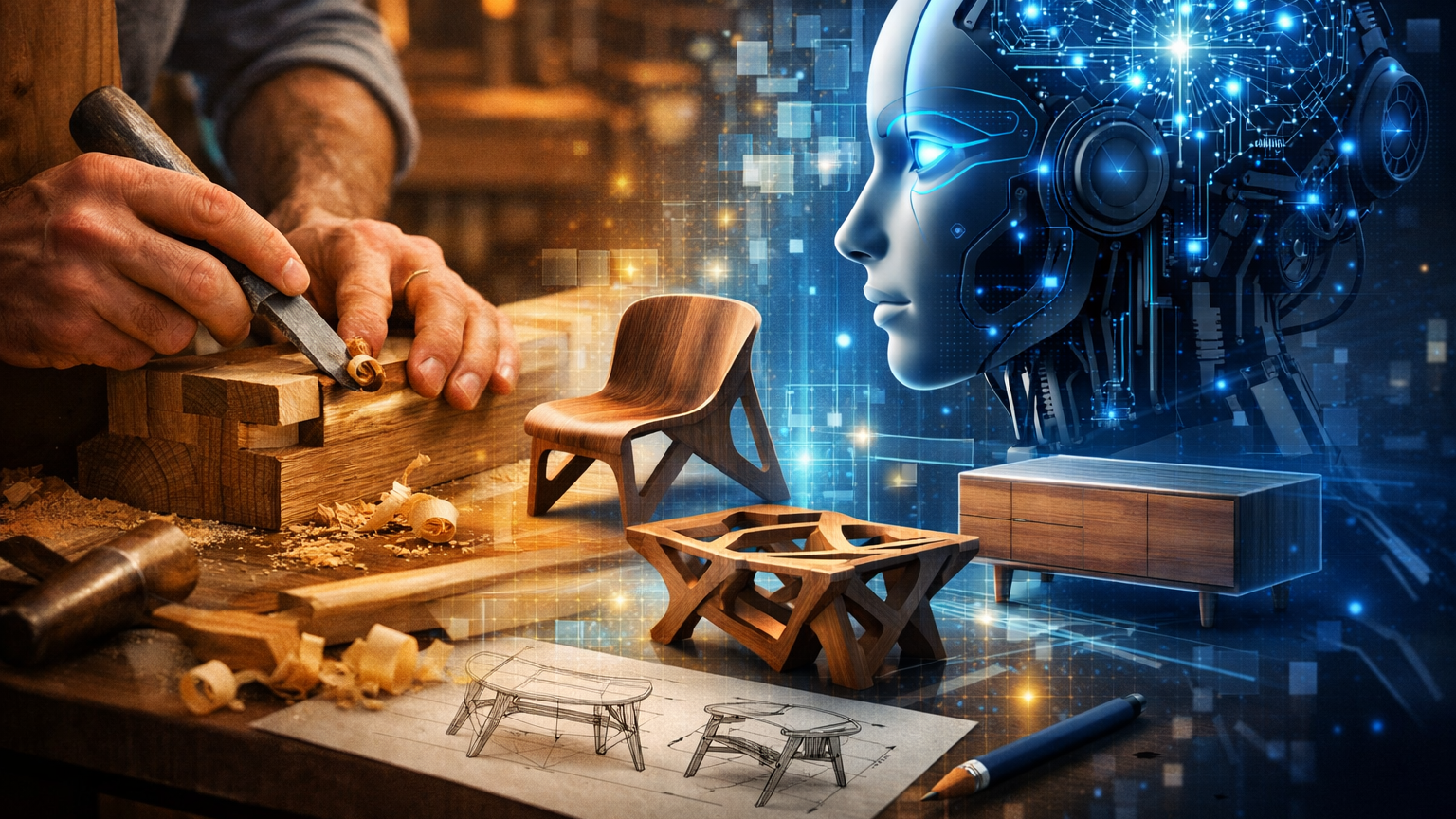
How AI Is Expanding Creative Boundaries for Woodworkers, Furniture Designers, and Makers
For generations, craftsmanship has been rooted in the hands: the feel of a hand plane gliding across grain, the sound of a chisel seating perfectly into a mortise, the intuition built from years of working with wood. In fields like woodworking, furniture design, and interior design, creativity has traditionally been driven by experience, observation, and experimentation. Artificial intelligence may sound out of place in this world—but quietly and rapidly, it’s becoming one of the most powerful creative allies craftspeople have ever had.
AI isn’t replacing the maker. It’s extending what’s possible.
AI as a Creative Partner, Not a Machine Overlord
In creative trades, the fear around AI often centers on automation and loss of authorship. But in practice, AI functions less like a robot and more like a sketchbook that never runs out of pages. It doesn’t dictate taste or craftsmanship—it responds to the creative direction you give it.
For a furniture designer, AI can generate dozens of design directions in minutes based on simple prompts: a Scandinavian dresser in solid white oak with exposed joinery, or a brutalist dining table carved from reclaimed timber. Instead of starting with a blank page, the maker starts with possibilities.
This accelerates ideation while preserving the designer’s role as editor, curator, and craft expert.
Pushing Beyond Familiar Design Patterns
One of the biggest creative challenges for experienced makers is creative gravity. After years in the craft, it’s easy to unconsciously repeat proportions, leg profiles, joinery styles, or layouts that have worked before. AI excels at breaking this pattern.
By blending references from different eras, cultures, and design philosophies, AI can surface combinations a human designer may not instinctively try:
Japanese timber framing influences merged with mid-century modern silhouettes
Sculptural, asymmetrical forms paired with traditional mortise-and-tenon construction
Ultra-minimal furniture forms that still highlight complex joinery
These concepts don’t arrive as finished products. They arrive as sparks—ideas that challenge assumptions and invite experimentation in the shop.
From Digital Concept to Physical Craft
AI-generated designs live in the digital realm, but their value increases when translated into real materials. For woodworkers, this creates a powerful feedback loop:
Generate a concept
Evaluate it through the lens of structural integrity and joinery
Adapt it for real-world tools, wood movement, and finishing
Build something entirely new
The craft knowledge still belongs to the maker. AI doesn’t understand grain direction, wood movement, or seasonal expansion—but the craftsperson does. This intersection is where innovation happens.
Many makers are discovering that AI allows them to design furniture that looks impossible at first glance—then solve the engineering and joinery challenges required to make it real.
Helping Makers Communicate Vision
Great design often fails not because it’s flawed, but because it’s misunderstood. AI-generated visuals are becoming a powerful communication tool for craftspeople working with clients, architects, or interior designers.
Instead of describing a concept verbally or relying on rough sketches, makers can present refined visual concepts that:
Show scale and proportion in realistic interiors
Demonstrate wood species, grain orientation, and finish tones
Communicate the emotional tone of a piece before it’s built
This is especially valuable for high-end, custom furniture where clients are investing in something unseen. AI bridges the gap between imagination and confidence.
Unlocking Confidence for New Creators
For emerging woodworkers and designers, AI can shorten the intimidating distance between beginner and visionary. Many creatives know what they like but struggle to express it visually or structurally.
AI tools help them:
Explore design styles quickly
Understand how different forms interact
Gain confidence in their aesthetic direction
Rather than copying existing furniture designs, new makers can experiment freely, refining taste before ever cutting wood. This democratizes design exploration without diminishing craftsmanship.
AI and Material Awareness
While AI doesn’t physically touch materials, it can help designers think more deeply about them. By prompting AI with constraints—solid wood only, no metal fasteners, visible joinery—makers can explore concepts aligned with traditional values.
Some craftspeople are using AI to:
Envision how unusual slabs or reclaimed timbers could be used
Explore exaggerated grain patterns as focal points
Design furniture that celebrates imperfections rather than hiding them
This approach aligns strongly with modern values of sustainability, authenticity, and material honesty.
Encouraging Risk Without Waste
One of the hidden costs of pushing design boundaries is material waste. Bold experimentation often requires trial-and-error, which can be expensive and environmentally taxing.
AI allows makers to explore risky ideas digitally first:
Unconventional leg angles
Extreme proportions
Sculptural negative space
Designs can be refined, rejected, or evolved before a single board is milled. This lowers the barrier to experimentation and encourages bolder creative decisions in the final build.
Preserving the Soul of Craft
The most important truth about AI in craftsmanship is this: tools don’t define the soul of the work—the maker does.
AI doesn’t understand why a hand-cut dovetail feels different than a machine-cut one. It doesn’t know the pride of flattening a slab by hand or the patience required to finish a piece perfectly. What it does provide is perspective, inspiration, and momentum.
In a world where many industries are becoming increasingly digital and disposable, AI can paradoxically help reinforce the value of slow, intentional, handmade work—by giving craftspeople better ideas worth building.
The Future: Imagination First, Tools Second
AI is not the future of woodworking, furniture design, or interior design. Craft is. But AI is becoming one of the most powerful imagination tools ever introduced to a traditionally hands-on industry.
For makers willing to experiment, AI offers:
Faster ideation
Bolder creative exploration
Better communication
Greater confidence
The envelope of design isn’t being pushed by machines—it’s being pushed by artists and craftspeople who are willing to combine timeless skills with modern tools.
The hands still build the work. AI simply helps the mind see further.

When the Sketchbook Was Empty, the Machine Wasn’t
Every maker knows the moment. You open the sketchbook. The page stays blank. Not because you lack skill—but because every idea feels already used.
Creative drought isn’t a failure. It’s a signal.
The problem isn’t that ideas are gone. It’s that familiar paths have been exhausted. When you’ve built enough tables, chairs, and cabinets, your mind starts protecting you from risk. It shows you what’s worked before and quietly hides everything else.
That’s where Furniture Lab AI steps in—not as a replacement for imagination, but as a spark when imagination is tired.
When the sketchbook offers nothing, the machine offers possibility. Not answers. Not solutions. Just prompts. Forms you wouldn’t draw on your own. Proportions you wouldn’t dare to sketch. Structures that make you lean closer and ask, Could this actually work?
That question reopens the door.
The blank page becomes a conversation instead of a judgment. You’re no longer asking yourself to invent from nothing. You’re reacting, refining, pushing back. Creativity returns through response.
This is how momentum starts again.
The machine doesn’t feel pressure. It doesn’t fear wasted time. It generates without attachment. That freedom gives the maker something invaluable: permission to explore.
Once an idea appears—any idea—the sketchbook fills again. Lines get messy. Notes stack up. Adjustments happen. The maker reclaims control, not by starting from zero, but by steering something forward.
Furniture Lab AI exists for these moments. The moments when skill is loud but inspiration is quiet. When experience needs interruption.
Because creativity doesn’t disappear. It waits for a reason to move.
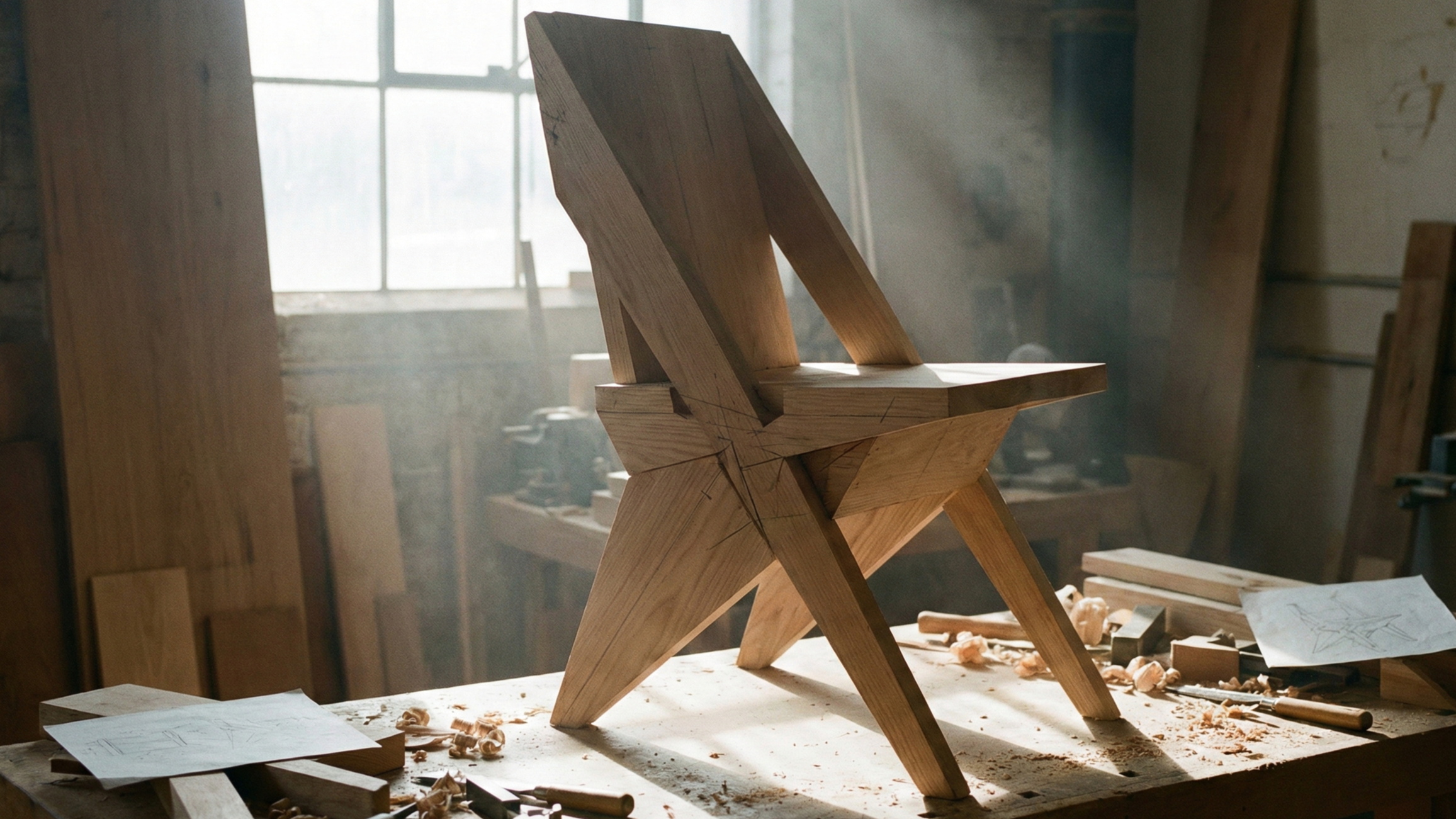
Why Perfection Is Boring and Discovery Isn’t
Perfection has a strange reputation in the world of furniture making. It’s admired, chased, measured, and photographed. But it’s also predictable. Clean. Finished. Safe.
And safe rarely sparks discovery.
Walk through any workshop and you’ll see it immediately: the pieces that follow rules and the pieces that ask questions. One fits perfectly into expectation. The other stops you in your tracks. Furniture Lab AI exists for the second kind.
Perfection implies an ending. Discovery implies a beginning.
Most furniture begins with a plan that already knows its outcome. Dimensions are locked. Joinery is familiar. The form has been solved before the first cut is made. That process produces consistency, but it rarely produces wonder.
Discovery, on the other hand, is uncomfortable. It doesn’t promise success. It doesn’t even promise usefulness. It asks the maker to step into uncertainty and trust their judgment instead of their habits.
This is where creativity actually lives.
When a design is too perfect, it leaves no room for conversation. The maker becomes a technician instead of a storyteller. The furniture becomes an object instead of an experience. But when discovery is allowed into the process, the piece begins to carry evidence of thought, risk, and evolution.
Furniture Lab AI doesn’t aim to replace craftsmanship—it aims to interrupt autopilot.
By generating concepts that don’t neatly align with existing categories, the platform forces a moment of pause. A moment where the maker asks, Why does this feel different? That question is more valuable than any blueprint.
Discovery often starts with friction. A leg angle that feels wrong at first glance. A massing choice that challenges balance. A joint that looks unfamiliar but somehow makes structural sense. These moments are not mistakes—they are invitations.
Perfection resists change. Discovery demands it.
The most memorable furniture pieces aren’t flawless. They carry fingerprints of decision-making. You can sense where the maker hesitated, adjusted, committed. Those moments give furniture its humanity.
AI, when used creatively, amplifies this process rather than dulling it. It offers ideas without ego. It suggests forms without insisting on correctness. It doesn’t know what’s “supposed” to be done—and that ignorance is powerful.
Discovery thrives in that gap.
A design that feels unresolved digitally often becomes the most exciting physical build. The maker steps in to interpret, refine, and translate. The machine proposes; the human decides.
That relationship restores balance to the creative process.
Perfection tells you when to stop. Discovery tells you to keep going.
Furniture Lab AI exists to keep you going—to explore ideas that may never make it to a showroom but absolutely belong in a workshop. Because originality doesn’t come from repeating excellence. It comes from chasing curiosity.
In the end, perfection makes furniture that looks good in photos. Discovery makes furniture that feels alive in a room.
And living things are never perfect.